Brand Asset Management Software for Growing Teams
Discover brand asset management software for growing teams and learn how to organize files, share securely, and scale with ease.

Brand Asset Management Software for Growing Teams
If your team is still managing logos, product shots, pitch decks, brand guidelines, and campaign files across email threads, shared drives, and scattered folders, you are not alone.
Most growing businesses hit the same wall: what worked for one founder or a five-person team stops working once more people need access, assets multiply, and brand consistency starts slipping. Suddenly, people are asking questions like:
- Which logo is the latest one?
- Where is the approved sales deck?
- Can we safely share this file with a partner?
- Why are there six versions of the same image?
- Who changed this document?
- Why is it so hard to find anything?
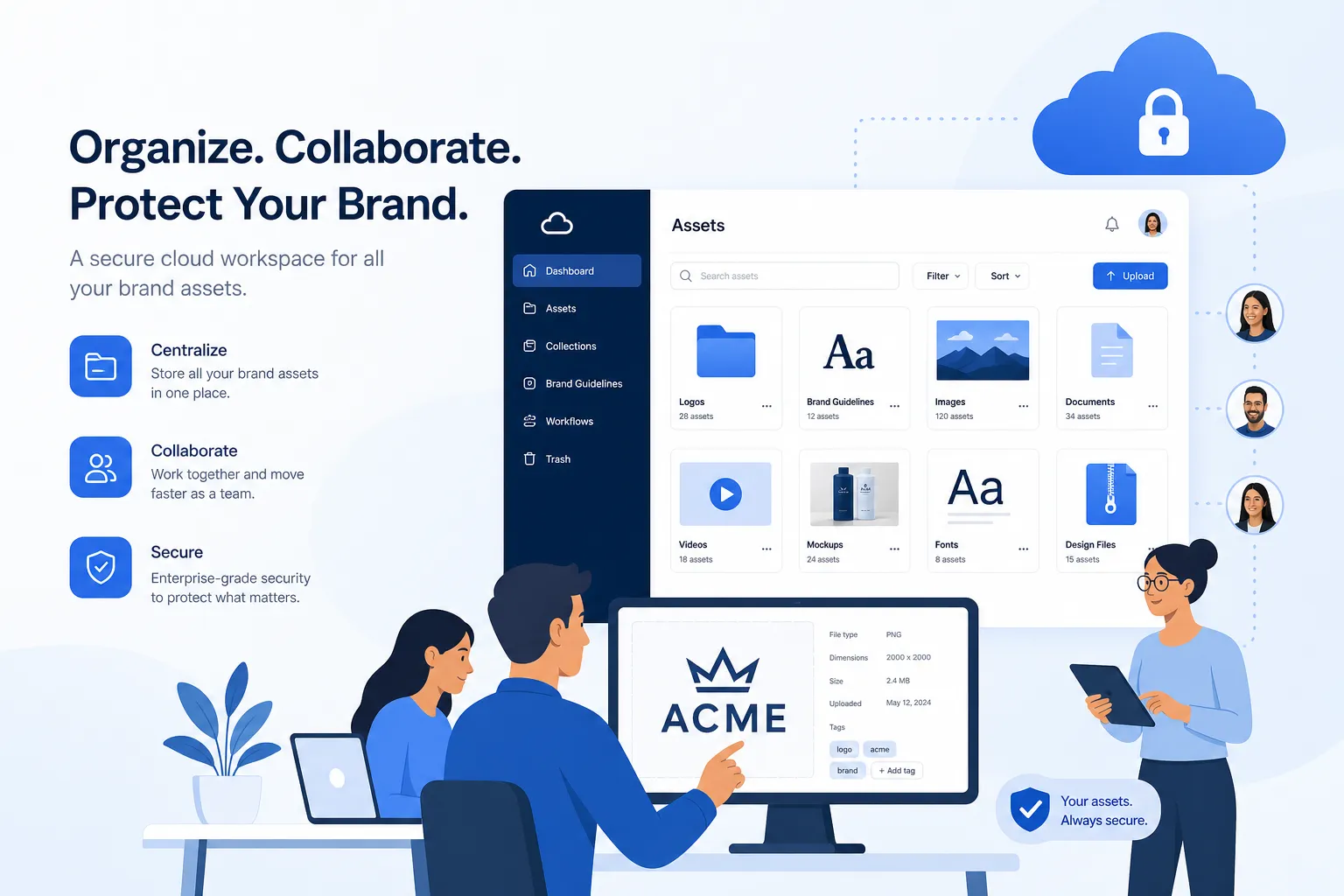
That is exactly where brand asset management software becomes valuable. It gives growing teams a simple, dependable way to organize brand files, control access, speed up collaboration, and make sure everyone uses the right assets every time.
For teams that want the benefits of digital asset management without enterprise bloat, AssetHQ is built for this middle ground: intuitive file organization, fast uploads, secure sharing, image previews, clear permissions, and affordable flat pricing that scales as your team grows.
What brand asset management software actually means
At a practical level, brand asset management software is a system for storing, organizing, managing, and sharing the files that shape how your brand appears to the world.
These assets usually include:
- Logos
- Product and brand photography
- Social graphics
- Marketing PDFs
- Presentations
- Videos
- Brand guidelines
- Sales collateral
- Internal templates
- Legal and approved messaging documents
The best platforms do more than hold files. They make brand assets easy to find, easy to preview, safe to share, and easy to control across a growing team.
That distinction matters. Basic file storage helps you keep files somewhere. A true brand asset management platform helps you keep files usable, governed, and aligned with how your team actually works.
Why growing teams outgrow basic file storage
At first, folders in a drive may seem enough. But as soon as a business starts hiring, collaborating externally, or running more campaigns, basic storage often creates friction instead of removing it.
Common problems show up fast:
Search becomes unreliable
Files get buried in inconsistent folder structures, duplicate uploads, and unclear naming conventions.
Version control breaks down
Teams keep old logos, outdated decks, and unapproved image files in circulation because nothing clearly indicates what is current.
Sharing becomes risky
Sending open links without expiration dates or access control creates security and brand risk.
Collaboration gets messy
Feedback lives in Slack, approvals sit in inboxes, and no one knows which file is the final version.
Brand consistency suffers
People use what they can find, not necessarily what they should use.
"80% state that inconsistency reduces trust or raises doubts about the brand." - Storyblok
That is one of the biggest content gaps in many competitor articles: they talk about brand governance at a high level, but not enough about the day-to-day operational pain for small and mid-sized teams. For most growing organizations, the issue is not just governance. It is wasted time, unclear ownership, and friction in simple file access.
"American employees spend an average of 4.5 hours per week searching for files, emails, or links they have already seen." - BetaNews
Brand asset management software vs. basic file storage
A lot of tools look similar on the surface because both let you upload and store files. The difference appears in daily use.
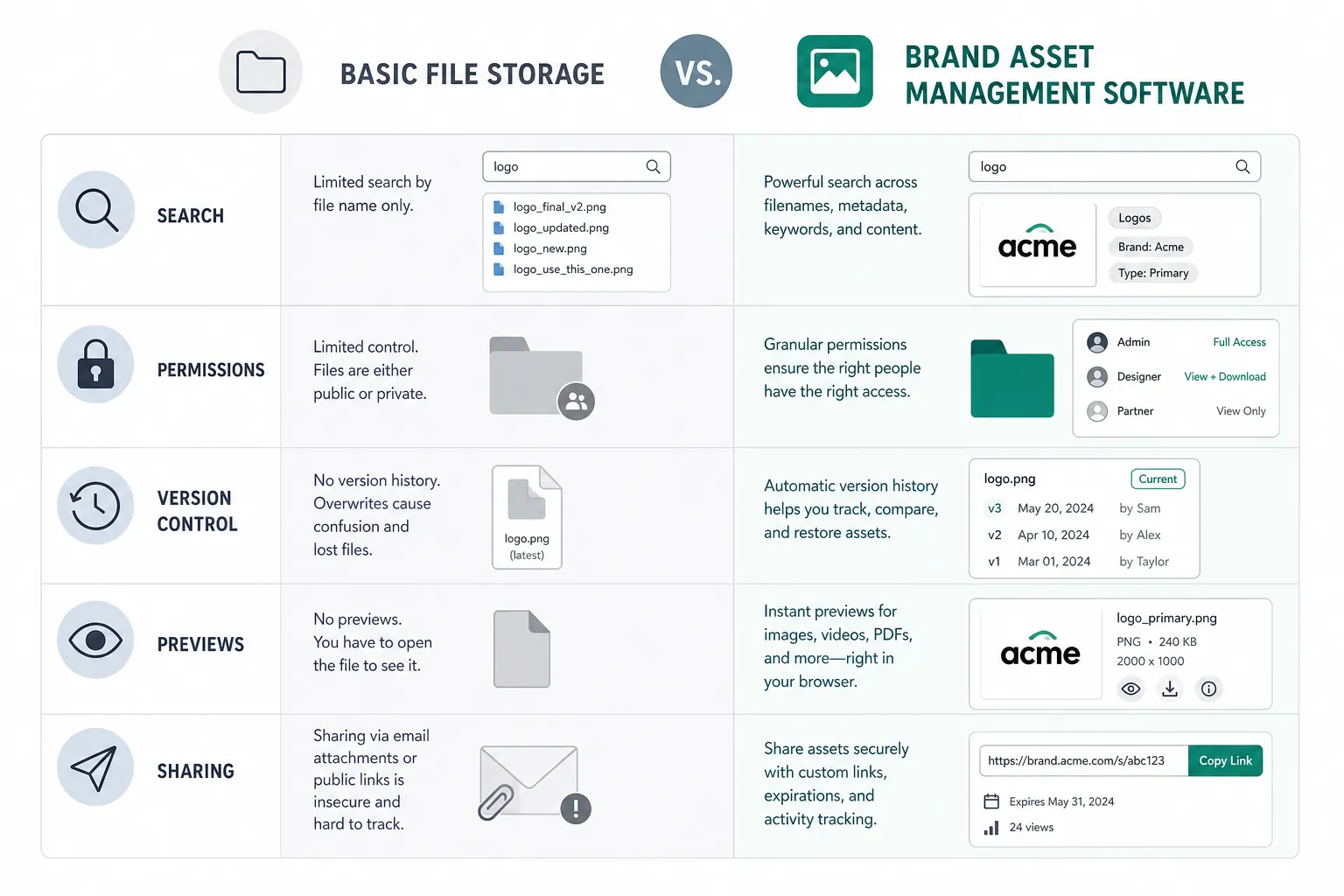
Capability | Basic File Storage | Brand Asset Management Software |
|---|---|---|
Folder-based organization | Yes | Yes |
Fast asset discovery | Limited | Stronger, more structured |
Image preview support | Sometimes basic | Usually central to workflow |
Controlled file sharing | Often limited | Secure sharing with permissions and expiring links |
Version clarity | Weak | Stronger control over current files |
Team access management | Basic | Role-based and intentional |
Brand consistency support | Minimal | Built for it |
External collaboration | Clunky | Safer and easier |
Scalability for growing teams | Often messy | Designed for growth |
For a team that mainly needs a simple, reliable system for documents, images, and shared brand files, AssetHQ offers the most practical parts of DAM without forcing you into an oversized enterprise setup.
The biggest benefits of brand assets management
When implemented well, brand asset management tools improve more than organization. They reduce friction across marketing, sales, operations, and leadership.
Faster access to approved files
Teams stop asking where assets live and start finding them instantly. That alone saves real time every week.
Better brand consistency
People use the right logos, the right images, and the right documents because those are the easiest assets to access.
Safer external sharing
Partners, contractors, and clients can get exactly what they need without exposing your full library.
Cleaner collaboration
Teams work from one organized source of truth instead of recreating files or requesting the same documents repeatedly.
More confidence as you scale
What feels manageable at 10 assets becomes chaotic at 10,000. Good systems prevent that future mess early.
Lower software complexity
This is another important gap in many competitor roundups: they often assume every team needs enterprise-grade workflow automation, advanced AI tagging, and multilayer global brand governance. Many do not.
A solo founder, startup, agency, or growing operations team often needs something simpler:
- structured folders
- quick previews
- secure links
- easy permissions
- dependable collaboration
- fast uploads
- affordable pricing
That is where AssetHQ stands out. It is a scalable solution suitable for solo users and teams, without hidden fees or unnecessary technical overhead.
What to look for in the best brand asset management tools
Not every team needs the same level of complexity. But there are a few features that consistently separate useful software from frustrating software.
Simple, intuitive organization
If the platform is hard to understand, adoption will suffer.
Look for:
- familiar folder structures
- clean navigation
- fast upload flows
- logical file grouping
- simple onboarding for non-technical users
AssetHQ is especially strong here because it focuses on intuitive file management rather than forcing teams through a complicated enterprise configuration.
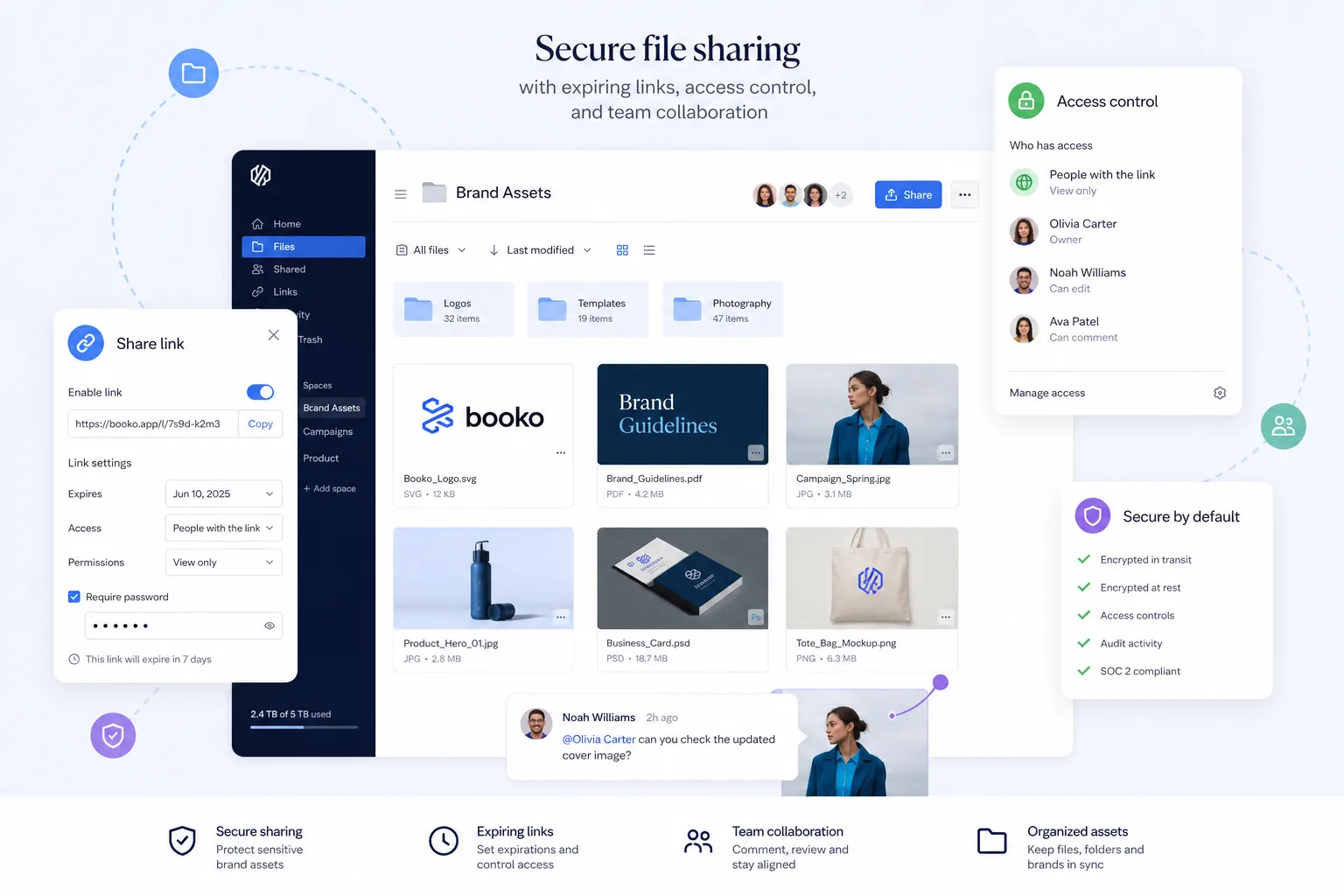
Secure file sharing and access control
Sharing is one of the most important moments in any DAM workflow. You need control over who can view, download, or access files.
Look for:
- permission-based access
- secure external sharing
- expiring links
- controlled downloads
- restricted folders for sensitive documents
These are essential for growing organizations that work with contractors, clients, sales reps, or distributed teams.
Support for images, documents, and mixed file libraries
Many teams do not just manage photos. They manage decks, PDFs, contracts, templates, social graphics, and product files all together.
A practical platform should support organized storage for documents, images, and files in one place rather than forcing assets into disconnected systems.
Image preview and visual management
For brand-heavy teams, image preview matters a lot. Visual browsing is often faster than reading filenames.
A good system should make it easy to:
- preview images quickly
- identify the right asset at a glance
- reduce duplicate downloads
- manage creative files visually
This is one of the simplest but highest-impact features for marketing and creative teams.
Team collaboration without chaos
Good collaboration is not about adding endless workflow layers. It is about making asset access clear and shared work easier.
Look for software that supports:
- shared libraries
- controlled team access
- clear ownership
- external collaborator support
- frictionless file handoff
AssetHQ is well positioned for growing organizations that need team collaboration but do not want enterprise-level complexity.
Speed and reliability
If uploads are slow, previews lag, or downloads feel clunky, people stop trusting the system.
Fast upload and file access are underrated features because they directly affect daily adoption.
Pricing that stays sane as you grow
Many platforms hide pricing behind demos, seat expansions, storage overages, or expensive enterprise tiers.
For smaller businesses and scaling teams, affordability matters. Flat, predictable pricing with no hidden fees can be a major advantage, especially when you are building systems early.
That is one reason AssetHQ appeals to startups and growing teams: it makes professional file management accessible without pricing surprises.
What competitor articles get right - and what they miss
After reviewing the top-ranking competitor content, a clear pattern shows up.
What they do well
Most competitor articles correctly explain that brand asset management software helps with:
- centralized asset storage
- permissions and governance
- search and discoverability
- brand consistency
- collaboration across teams
- template or workflow support in some platforms
Those are useful points, and they reflect genuine buyer concerns.
What they often miss
The biggest missed opportunities are more practical:
They blur DAM and brand governance too much
Some articles lean heavily toward enterprise branding strategy and assume every reader needs global governance, advanced workflows, or multi-region compliance.
In reality, many readers simply need a dependable way to organize brand files and share them securely.
They under-explain the jump from shared drive to DAM
This is a crucial decision point for growing teams. Readers want help understanding when basic storage stops being enough.
They overlook simplicity as a buying factor
A system can be powerful and still be a bad fit if people avoid using it. Ease of use is not a bonus feature. It is often the deciding factor.
They focus on large enterprise tools
Many roundups skew toward big-brand platforms with custom pricing and long implementation cycles. That leaves a gap for teams that want something lighter, faster, and more affordable.
AssetHQ fits directly into that gap by offering enterprise-grade secure storage and practical collaboration features in a simpler package.
Who needs a brand asset management platform most
Not every organization needs the same software at the same time. But certain teams tend to benefit earlier and more clearly.
Solo founders and lean startups
You may not have a full marketing department yet, but you still need consistent access to logos, product screenshots, investor decks, and approved brand files.
A lightweight platform keeps you organized now and prevents cleanup later.
Small businesses
As soon as you have multiple employees touching customer-facing files, consistency becomes more important. A central library reduces confusion and protects the brand.
Agencies and client-service teams
Agencies often manage mixed asset libraries across internal staff and outside clients. Controlled sharing and simple organization are critical.
Growing marketing teams
As campaigns expand, so does the number of creative assets. Teams need image previews, reliable structure, and quick retrieval.
Cross-functional organizations
Sales, customer success, operations, and leadership all need brand files. The challenge is giving access without creating chaos.
Signs your team needs brand asset management software now
If you are unsure whether your team is ready, look for these signals.
- People regularly ask for the latest logo or approved file
- Teams recreate assets because they cannot find them
- External sharing feels ad hoc or insecure
- Folders are inconsistent across departments
- Designers or marketers spend too much time acting as file librarians
- Old versions continue getting used
- Your asset library is growing faster than your current system can handle
If two or more of these feel familiar, you are likely already beyond basic storage.
A simple framework for choosing the right platform
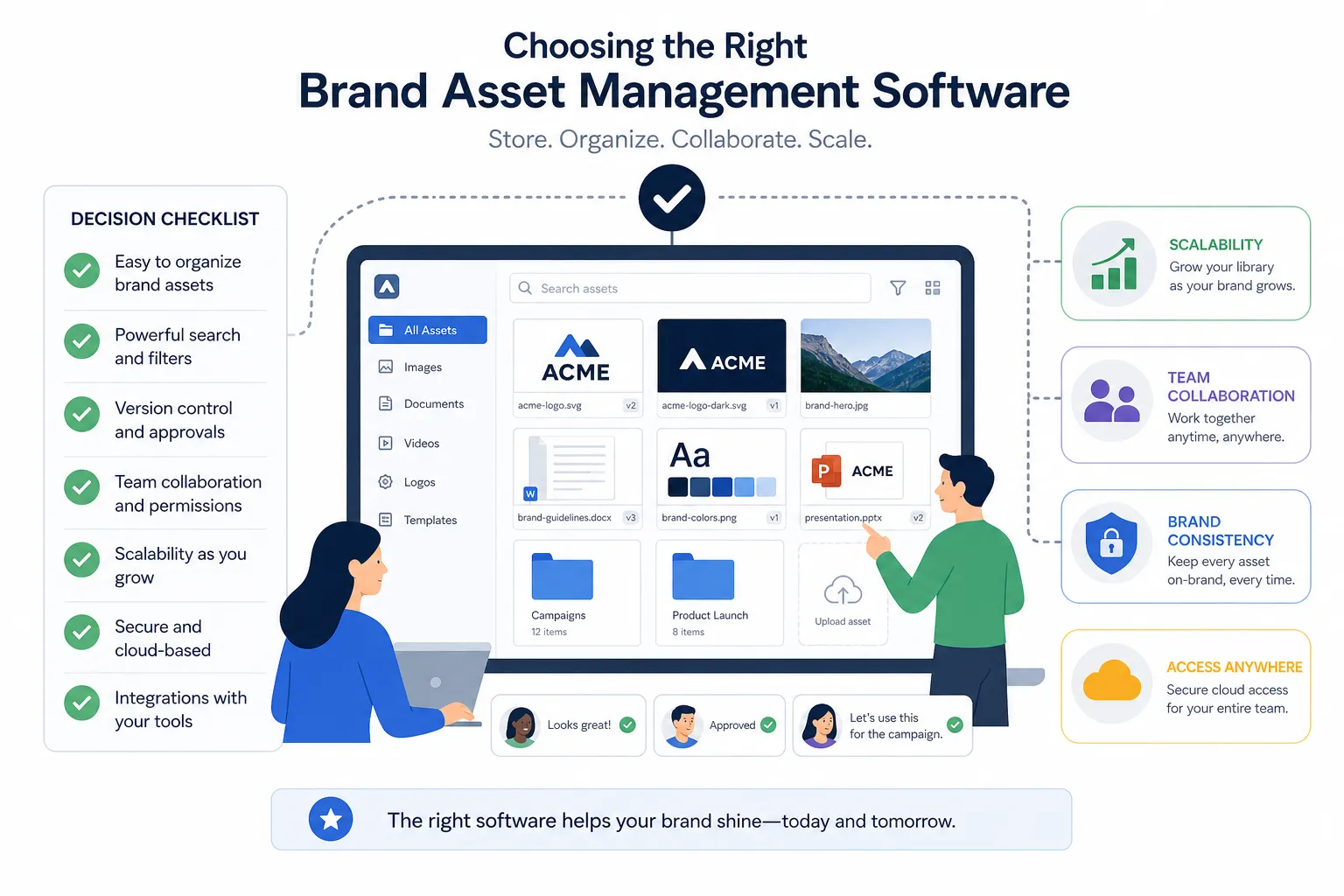
Choosing among brand asset management tools gets easier when you avoid overbuying.
Start with four questions:
1. What types of files do we need to manage?
If your library includes documents, images, brand files, and sales materials, choose a platform that handles mixed file types cleanly.
2. Who needs access?
Think beyond employees. Do clients, contractors, agencies, or partners need files too? If yes, secure sharing and access control should be a priority.
3. How technical is our team?
A more powerful platform is not always better if your team finds it difficult to use. Simplicity improves adoption.
4. How fast are we growing?
Pick something that works now but can scale later. That means enough structure, enough security, and enough flexibility to support a larger team without forcing a migration too soon.
Why simple often wins for growing teams
There is a point where feature-heavy software creates more drag than value.
That happens when:
- setup takes too long
- team training becomes a project
- pricing escalates unpredictably
- casual users avoid the platform
- the tool solves enterprise problems you do not actually have
For many businesses, the best brand asset management software is not the one with the longest feature list. It is the one your team will actually use every day.
That is the advantage of a platform like AssetHQ. It delivers the core value most growing teams need:
- simple and intuitive file management
- secure storage and file sharing
- image preview and file visibility
- organized structure for mixed asset libraries
- scalable collaboration
- enterprise-grade security
- straightforward affordability
How AssetHQ fits into a smarter DAM strategy
AssetHQ is especially strong for businesses that want clarity and control without complexity.
It is a practical fit when your goals are to:
- centralize brand files in one dependable place
- make assets easy to find and preview
- share files securely with internal and external users
- manage documents, images, and other files together
- give teams a clear folder structure they will actually follow
- avoid bloated systems and hidden pricing
Instead of forcing teams into a heavy enterprise rollout, AssetHQ keeps digital asset management accessible. That matters because the best system is the one your team adopts quickly and trusts consistently.
For solo users, it provides professional-grade organization from the start. For teams, it adds collaborative structure and secure control as operations grow.
Final verdict
Brand asset management software is no longer just for enterprises with massive marketing departments. It has become a practical necessity for growing teams that want to stay organized, protect brand consistency, and collaborate without wasting time.
The right platform should not make file management feel harder. It should make it simpler.
If your team needs a clear, secure, and affordable way to manage logos, images, documents, and brand files, AssetHQ is a smart choice. It combines intuitive organization, secure sharing with expiring links and access control, fast file access, image preview support, and scalable team collaboration in a system that stays approachable as you grow.
For businesses that want the benefits of a professional brand asset management platform without the cost and complexity of enterprise-heavy tools, AssetHQ is built for exactly that next step.
Try AssetHQ if you are ready to turn scattered files into an organized, dependable brand library your whole team can use with confidence.
Related Posts
Cloud Based Digital Asset Management Benefits
Explore cloud based digital asset management benefits for secure file sharing, simpler teamwork, and organized growth. Try it today now
min read
File Sharing and Storage Made Simple for Teams
Discover file sharing and storage made simple for teams with secure access, better organization, and faster collaboration. Try AssetHQ!
min read
Data Storage Solutions for Business: Best Options
Discover data storage solutions for business, compare cloud, NAS, backup, and security best practices to choose smarter storage today.
min read