Cloud Based Document Management Benefits
Cloud Based Document Management Benefits If your team is still juggling files across email threads, desktop folders, shared drives, and scattered cloud apps, document management quickly becomes a productivity problem. People waste time searching for the latest version, permissions get messy, and simple collaboration starts to feel harder than it should. Cloud based document management solves that by giving teams one secure, accessible place to store, organize, manage, and share files. For solo
 Kevin SimphiweJune 24, 20269 min read
Cloud Based Document Management Benefits
If your team is still juggling files across email threads, desktop folders, shared drives, and scattered cloud apps, document management quickly becomes a productivity problem. People waste time searching for the latest version, permissions get messy, and simple collaboration starts to feel harder than it should.
Cloud based document management solves that by giving teams one secure, accessible place to store, organize, manage, and share files. For solo founders, startups, and growing businesses, the appeal is simple: less friction, better control, and a system that scales without becoming expensive or overly complex.
A modern approach to document management is not just about moving files online. It is about creating a dependable structure for everyday work: fast uploads, intuitive folders, secure sharing, clear access controls, and easy collaboration across documents, images, and other important assets. That is exactly where AssetHQ fits in - offering a clean, affordable way to manage files professionally without the usual enterprise-heavy setup.
"Knowledge workers spend approximately 1.8 hours per day, or about 9 hours per week, searching for information." - DocZoom
What cloud based document management actually means
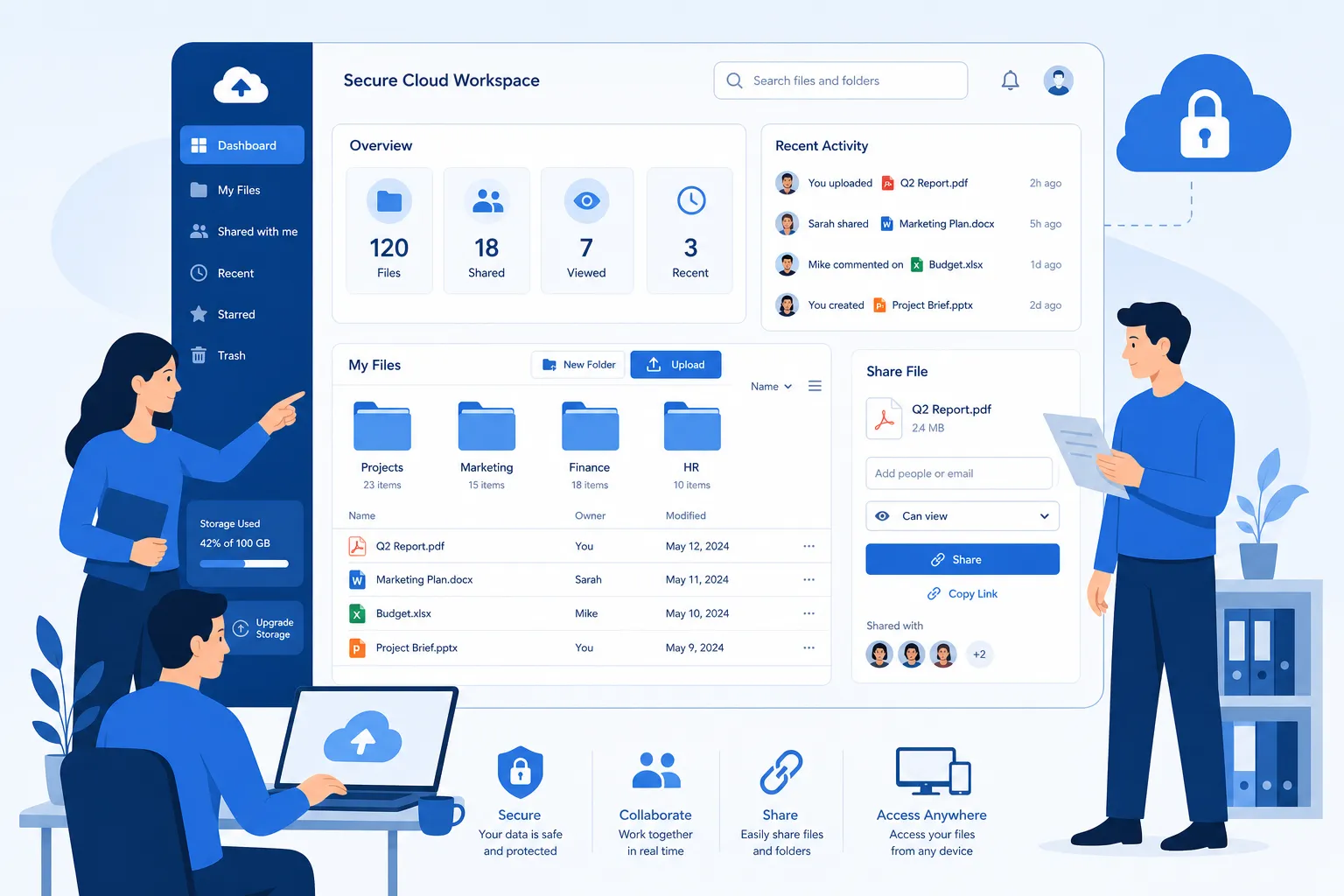
Cloud based document management is a system for storing, organizing, accessing, and sharing files through the internet instead of relying only on local devices or on-premise servers.
In practical terms, that means your documents live in a secure online environment where authorized users can:
- upload and organize files
- control access by user or team
- share documents internally or externally
- preview and manage images and other assets
- retrieve files quickly from anywhere
- avoid version confusion and folder chaos
This is different from basic file dumping. A proper system adds structure, control, and collaboration to everyday file handling.
For many businesses, cloud based document storage is the foundation. Document management is the next step - the layer that makes storage actually useful through organization, permissions, and team workflows.
Why businesses are moving away from traditional file management
Competitor articles consistently emphasize accessibility, cost savings, scalability, and security. Those are real benefits, but many gloss over the day-to-day problem that drives adoption first: file systems become frustrating long before they become technically outdated.
Here is what usually pushes teams to make the change:
Files are spread across too many places
Important documents often end up split between laptops, email attachments, shared folders, messaging apps, and old drives. That makes it difficult to know where the real source of truth lives.
Collaboration gets messy as teams grow
What works for one person breaks down for five. What works for five breaks down for twenty. A growing team needs shared visibility, consistent structure, and reliable permissions.
Sharing becomes a security risk
Sending sensitive files as email attachments or open links creates unnecessary exposure. Teams need secure sharing with access control and expiration options.
Old systems are hard to maintain
On-premise setups and bloated enterprise tools often come with unnecessary complexity, hidden costs, and IT overhead that smaller teams do not want.
People lose time on simple tasks
The true cost is not just infrastructure. It is the wasted effort of finding files, re-uploading assets, asking for access, or recreating missing documents.
The core benefits of cloud based document management
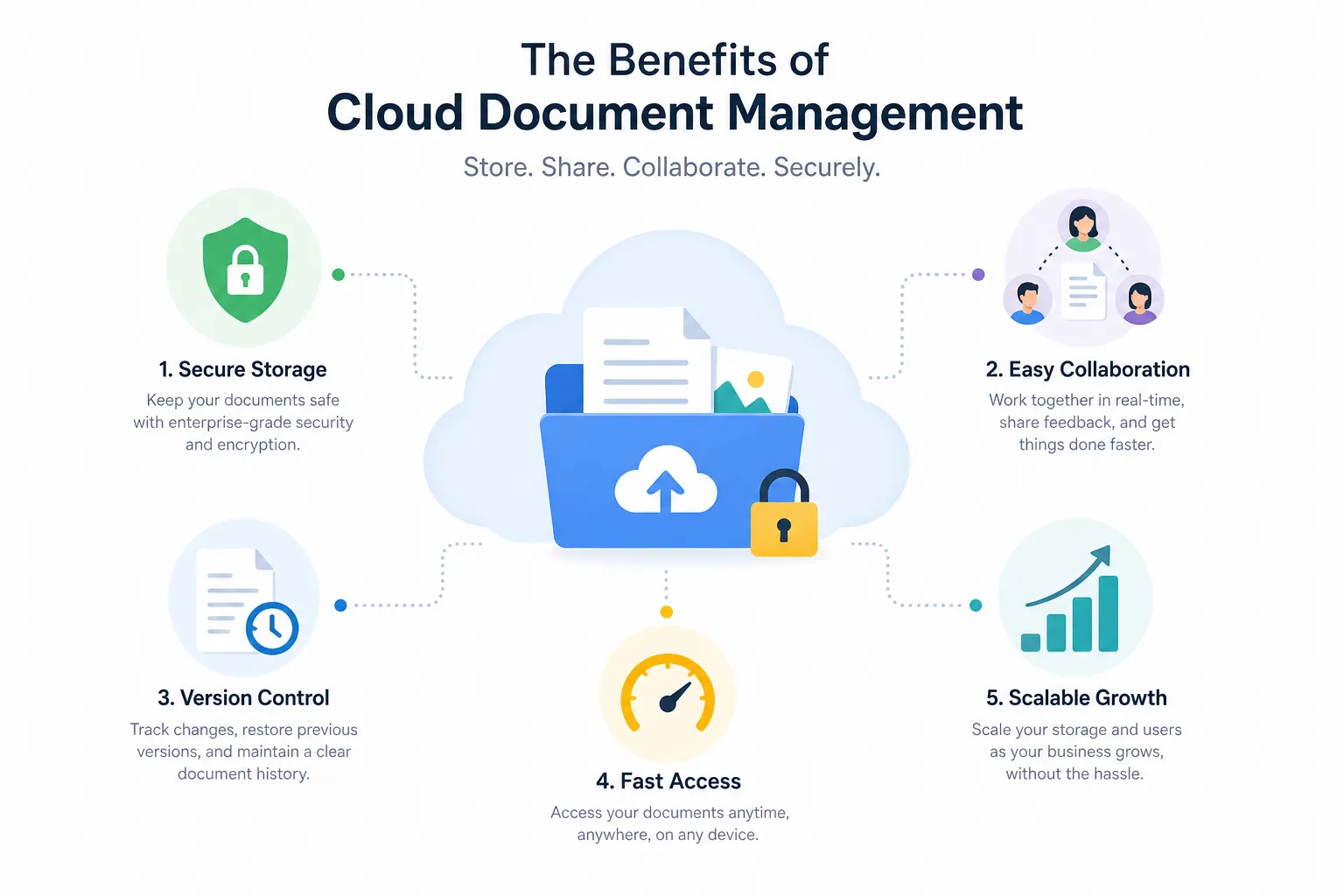
The biggest value of cloud based document management is that it improves both control and convenience at the same time.
1. Access from anywhere
Teams can work from the office, home, on the road, or across multiple locations without losing access to critical files. That matters for modern businesses where work is no longer tied to a single physical location.
The benefit is not just remote access. It is dependable access. When files live in one organized cloud system, your team spends less time hunting and more time working.
2. Better file organization
This is where many articles stay too high-level. Storage alone is not enough. Teams need a system that is intuitive enough to actually use consistently.
A good platform should make it easy to:
- create a logical folder structure
- separate departments, clients, or projects
- keep documents and images neatly categorized
- preview files quickly
- reduce duplication and clutter
AssetHQ is especially strong here because it focuses on simple, intuitive file management rather than overwhelming users with unnecessary layers of complexity.
3. Safer sharing
External sharing is one of the most common file tasks - and one of the easiest to mishandle.
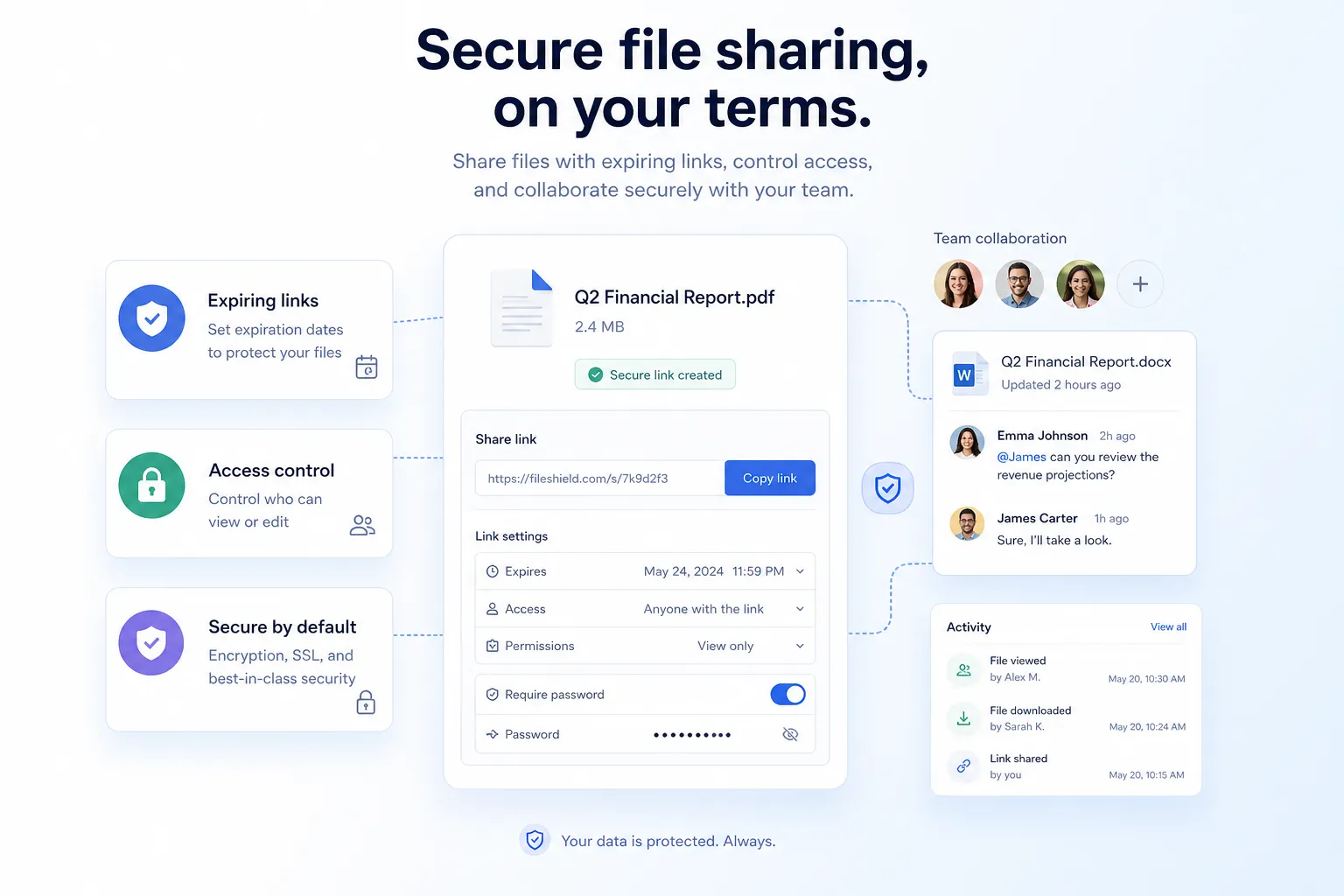
With secure cloud-based tools, teams can share files using controlled links instead of unsecured attachments. Features such as expiring links and permission settings help you decide who can view or access a file, and for how long.
That makes sharing more professional and more secure at the same time.
4. Stronger collaboration
A document system should help a team move faster together. Centralized storage makes it easier for everyone to work from the same materials instead of managing duplicate copies in parallel.
For growing organizations, collaboration improves when people can:
- find shared assets quickly
- access the same updated files
- avoid sending large attachments repeatedly
- manage team resources in one place
- keep internal and external sharing clearly separated
5. Improved security and control
Security is one of the most common selling points in competitor content, but the most important point is simple: centralization makes control easier.
When files are managed in one secure platform, you can apply consistent rules around who gets access, what gets shared, and how long assets remain available. That is much safer than relying on local files, casual sharing habits, or untracked attachments.
AssetHQ supports this with enterprise-grade secure storage and access controls, making it suitable for solo users and teams alike who want dependable protection without enterprise complexity.
6. Faster growth without system sprawl
As a business grows, so does its file volume. More documents, more images, more collaborators, more customer assets, more approvals.
A scalable cloud system lets you handle that growth without rebuilding your process from scratch. You do not need to jump immediately into oversized enterprise software. Many teams benefit more from a tool that stays easy to use as volume increases.
7. Lower overhead and clearer pricing
On-premise systems and complex software stacks often come with hidden costs: IT setup, maintenance, upgrades, storage planning, and user training.
Cloud tools simplify that. And the best options do not just reduce technical overhead - they also keep pricing predictable.
That is another area where AssetHQ stands out: affordable flat pricing, no hidden fees, and a straightforward value proposition for teams that want professional file management without paying for features they will never use.
Cloud document management vs. basic cloud storage
This is a major content gap in many competitor articles. They explain the cloud, but they do not clearly separate simple storage from actual document management.
Here is the difference:
Feature | Basic Cloud Storage | Cloud Document Management |
|---|---|---|
File upload | Yes | Yes |
Central online access | Yes | Yes |
Folder organization | Usually basic | More structured and intentional |
Access control | Limited or generic | More deliberate and manageable |
Secure external sharing | Sometimes | Usually a core workflow |
Team collaboration | Basic | Designed for ongoing shared use |
Asset visibility | Limited | Better browsing, preview, and retrieval |
Scalability for operations | Moderate | Stronger for growing teams |
Basic storage helps you keep files online. Document management helps your team use those files effectively.
That is why businesses often outgrow generic storage tools. The issue is not whether the files are in the cloud. The issue is whether people can actually manage them well.
The most important features to look for
Not every business needs heavy workflow automation or industry-specific compliance tooling. But almost every business does need the basics done extremely well.
Intuitive organization
If a system is hard to structure or browse, adoption drops. Teams need a clear folder-based experience that feels familiar and fast.
Secure file sharing
Look for controlled sharing options, including access restrictions and expiring links, especially if you regularly send files to clients, contractors, or external partners.
Fast uploads and file access
A slow system creates friction. Speed matters both when uploading large batches and when retrieving files under pressure.
Team access controls
As teams grow, not everyone should see everything. Role-based or controlled access makes collaboration safer and cleaner.
Image preview and asset visibility
For teams working with visual assets, image preview support is a real operational benefit. It saves time and makes asset management easier.
Simplicity over bloat
Many businesses do not need a massive enterprise platform. They need a reliable, easy-to-learn system that works immediately and stays manageable over time.
How cloud based document management improves real workflows
Benefits matter most when they improve actual daily work. Here is how that usually looks in practice.
For solo founders
A solo operator needs one organized place for brand files, contracts, invoices, images, proposals, and internal documents. The right setup reduces clutter and gives them a scalable foundation before the business grows.
For startups
Startups move fast, which often means files get messy fast too. A cloud-based system creates order early - before assets become scattered across tools and people.
For small businesses
Small businesses often need a better way to manage shared documents without hiring IT or implementing complicated software. They benefit from straightforward storage, secure sharing, and team collaboration.
For growing teams
As more people join, permissions, file visibility, and shared access become more important. A platform like AssetHQ helps teams grow into better file management without jumping to a complex enterprise DAM too early.
Common mistakes to avoid when choosing a solution
Another area competitors often skip is decision mistakes. Here are the most common ones.
Choosing a tool that is too complicated
A platform can be powerful and still be the wrong fit. If everyday users avoid it, the system fails no matter how advanced it is.
Focusing only on storage limits
Storage capacity matters, but usability matters more. A tool should help you manage files well, not just hold more of them.
Ignoring external sharing workflows
If your team regularly sends files outside the company, secure sharing should be a priority from day one.
Underestimating visual asset needs
If you manage images, marketing files, product assets, or branded content, preview and browsing capabilities matter a lot more than many generic storage tools suggest.
Paying for features you do not need
Some teams buy oversized systems because they assume more features means better value. Often, a simpler, more focused platform delivers faster adoption and lower long-term cost.
What makes AssetHQ a smart fit for modern teams
Many businesses do not need a bloated digital asset management suite or a complicated document platform. They need something clean, dependable, and secure.
That is where AssetHQ fits naturally into the conversation around cloud based document management.
Why it works well
- simple and intuitive file management
- organized storage for documents, images, and shared files
- secure file sharing with expiring links and access control
- image preview and management capabilities
- collaboration features for solo users and teams
- enterprise-grade secure storage
- fast upload and file access
- affordable flat pricing with no hidden fees
- scalable setup for growing organizations
This combination matters because it meets the needs most small and mid-sized teams actually have. You get the structure and professionalism of a dedicated file management platform without the drag of enterprise-heavy software.
A practical framework for deciding if you need it
If you are wondering whether now is the right time to improve your file setup, ask these questions:
Question | If the answer is yes | What it suggests |
|---|---|---|
Do people struggle to find the latest file? | Frequent confusion | You need better organization |
Are files shared through email attachments often? | Regularly | You need safer external sharing |
Do multiple people need access to the same assets? | Yes | You need centralized collaboration |
Are images and documents stored across too many tools? | Yes | You need consolidation |
Is your current setup hard to scale? | Yes | You need a simpler long-term system |
Do you want predictable pricing? | Yes | Avoid bloated enterprise tools |
If several of these sound familiar, cloud based document management is likely not just helpful - it is overdue.
Final verdict
The benefits of cloud based document management are not limited to remote access or lower infrastructure costs. The real value is operational clarity. Your team gets one reliable place to store files, organize them properly, share them securely, and collaborate without confusion.
That matters even more for solo founders, startups, small businesses, and growing teams that need professional file management without extra complexity.
AssetHQ is a strong choice because it delivers what modern teams actually need: simple organization, secure sharing, image and file visibility, scalable collaboration, enterprise-grade protection, and affordable pricing without hidden fees.
If you want a cleaner, easier way to manage documents, images, and shared files in the cloud, AssetHQ gives you a practical path forward - without the bloat.
FAQ
What is the advantage of using cloud storage for document management?
The biggest advantage is easy, secure access to files from anywhere while keeping everything organized in one place. It also improves collaboration, reduces version confusion, and makes file sharing much safer with access controls and expiring links.
What is cloud-based document management?
Cloud-based document management is a way to store, organize, manage, and share documents through an online system instead of relying on local devices or office servers. It helps teams centralize files, control access, and collaborate more efficiently.
What are two benefits of a cloud-based system?
Two major benefits are anywhere access and better collaboration. Teams can retrieve files quickly from any location and work from the same organized, up-to-date set of documents.
What are the benefits of document management system?
A document management system improves organization, security, and efficiency. It helps teams find files faster, manage permissions more reliably, share documents safely, and scale their file operations as the business grows.
Related Posts

Brand Asset Management Software for Growing Teams
Discover brand asset management software for growing teams and learn how to organize files, share securely, and scale with ease.
min read
Cloud Based Digital Asset Management Benefits
Explore cloud based digital asset management benefits for secure file sharing, simpler teamwork, and organized growth. Try it today now
min read
File Sharing and Storage Made Simple for Teams
Discover file sharing and storage made simple for teams with secure access, better organization, and faster collaboration. Try AssetHQ!
min read