Digital Asset Management Platforms Explained
Digital Asset Management Platforms Explained If your files are scattered across email threads, shared drives, desktops, Slack messages, and random folders called “final-final-v2,” you are already feeling the problem digital asset management platforms are built to solve. For solo founders, startups, small businesses, and growing teams, the challenge is not just storing files. It is finding the right file fast, knowing it is the current version, sharing it securely, and keeping work organized as
 Kevin SimphiweMay 17, 202610 min read
Digital Asset Management Platforms Explained
If your files are scattered across email threads, shared drives, desktops, Slack messages, and random folders called “final-final-v2,” you are already feeling the problem digital asset management platforms are built to solve.
For solo founders, startups, small businesses, and growing teams, the challenge is not just storing files. It is finding the right file fast, knowing it is the current version, sharing it securely, and keeping work organized as more people join the process. That is where digital asset management platforms come in.
A digital asset management platform, often shortened to DAM, gives you a central place to store, organize, preview, search, and share digital files like documents, images, brand assets, videos, presentations, and other business content. The best platforms also help teams collaborate without adding enterprise-level complexity.
AssetHQ is built for exactly this need: simple and intuitive file management, secure sharing, fast access, image previews, organized storage, and affordable scalability for both solo users and teams. In other words, it gives businesses the practical benefits of DAM without the bloat.
What digital asset management platforms actually do
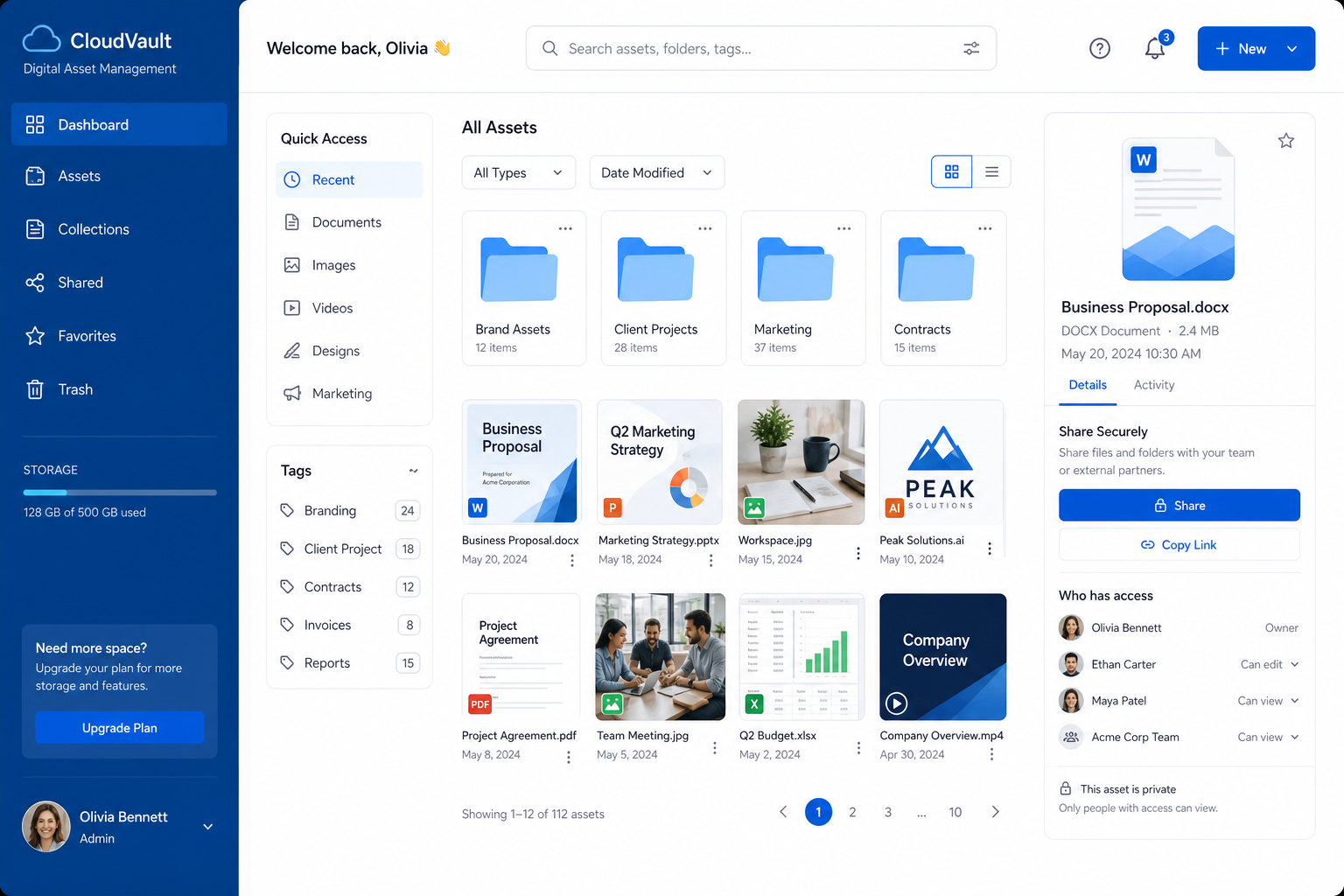
At a basic level, digital asset management platforms act as a central home for your files. But a good DAM platform does much more than simple storage.
It helps your business:
- Store files in one organized location
- Keep documents, images, and brand assets easy to browse
- Search by folder structure, naming, and metadata
- Preview visual assets without downloading them
- Share files securely with teammates, clients, or partners
- Control who gets access to what
- Reduce confusion around versions and duplicates
- Support collaboration as your team grows
This matters because file chaos compounds quickly. A team with 500 files becomes a team with 5,000 files faster than expected. Without a system, simple tasks start taking too long: finding the latest product image, sending the right PDF to a client, locating an approved logo, or checking whether a contractor should still have access.
A DAM platform brings order to that workflow.
Why businesses use digital asset management platforms
Businesses do not adopt DAM software because it sounds sophisticated. They adopt it because disorganized file management creates friction in daily work.
Common problems teams face before using a DAM platform
Many businesses start with a mix of cloud storage, local folders, and chat-based sharing. That works for a while, until it does not.
Typical pain points include:
- Files living in too many places
- Outdated versions being shared by mistake
- Slow manual searching
- No clear structure for assets
- Weak visibility into who has access
- Difficult collaboration with external users
- Lost time recreating files that already exist
- Poor handling of image-heavy workflows
For smaller organizations especially, the issue is often that enterprise tools feel too heavy, while consumer file-sharing tools feel too basic. The sweet spot is a platform that is dependable, secure, and easy to use.
The real business value of DAM
The value of digital asset management platforms is practical:
- Faster file retrieval
- Better organization
- Cleaner collaboration
- Lower risk
- More consistent brand usage
- Less wasted time
- Easier scaling as teams grow
"In 2023, the digital asset management market was valued at approximately USD 4.22 billion and is projected to reach USD 11.94 billion by 2030." - Grand View Research
That growth reflects a simple reality: businesses are producing and sharing more digital content than ever, and ad hoc file storage is no longer enough.
How digital asset management platforms work
Most digital asset management platforms follow the same core workflow.
1. Upload and centralize files
Teams upload documents, images, videos, and other assets into one secure system. Instead of spreading files across personal tools and disconnected drives, everything lives in a shared, accessible home.
With AssetHQ, this process stays simple. You get organized file storage without unnecessary setup overhead, which is ideal for teams that want to move quickly.
2. Organize files clearly
Once inside the platform, files are arranged in folders, collections, categories, or tagged structures. This is critical because storage alone is not the same as usability.
The best systems help users create a structure that feels intuitive from day one.
For growing teams, this usually means:
- Clear folder hierarchy
- Logical naming conventions
- Dedicated spaces for departments, clients, or campaigns
- Easy browsing for visual content
3. Search and preview assets
A DAM platform should make finding files fast. Strong search is one of the biggest reasons teams upgrade from generic storage tools.
This includes:
- Keyword search
- Folder-based navigation
- Filters
- Image previews
- Quick file access without unnecessary downloads
Image preview support is especially important for teams managing visual assets. If users must download five files just to identify the right one, the system is still too slow.
4. Share files securely
Secure sharing is where a true DAM platform separates itself from basic storage tools.
Teams often need to send files to:
- Clients
- Contractors
- Agencies
- Partners
- Internal departments
A good platform lets you do that while staying in control. AssetHQ makes this practical with secure file sharing, expiring links, and access control, so you can share confidently without losing visibility.
5. Collaborate without confusion
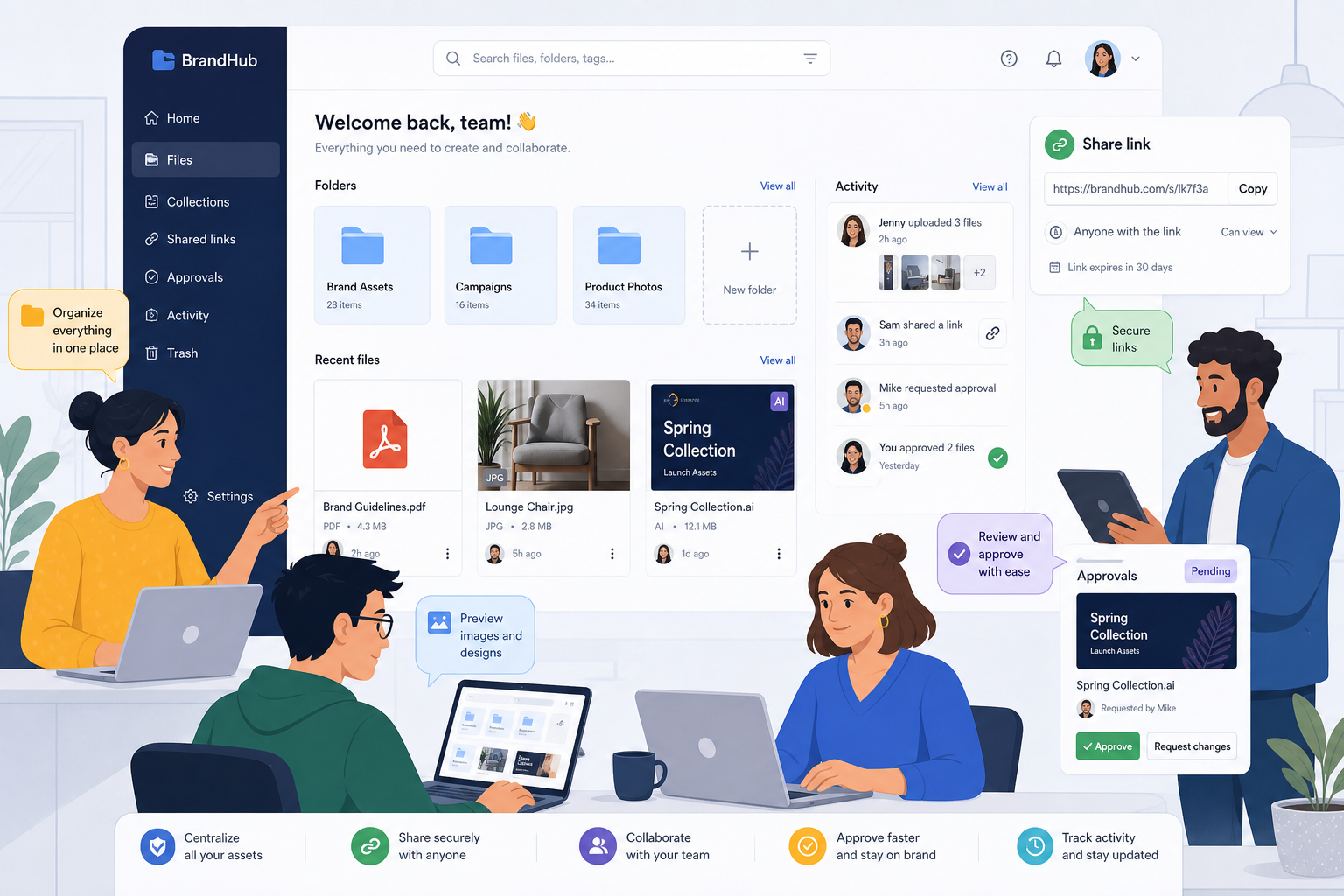
As teams grow, more people need to access the same asset library. The right platform supports collaboration without making file management messy.
This includes:
- Shared access
- Permission settings
- Team-friendly organization
- Fast uploads and downloads
- Reliable access from a central source of truth
Core features to look for in digital asset management platforms
Not all digital asset management platforms are built alike. Some are enterprise-heavy systems designed for global marketing operations. Others are much better suited to small and mid-sized teams that need straightforward file management.
Here are the features that matter most.
Centralized storage
This is the foundation. Your team needs one place where important files live.
Look for:
- Support for documents, images, and common file types
- Reliable upload and access speed
- Scalable storage
- Clear folder structure
AssetHQ is especially strong here because it focuses on organized storage without overcomplicating the experience.
Simple file organization
The platform should help people stay organized naturally, not force them into a complicated taxonomy that nobody actually uses.
Useful capabilities include:
- Folder-based structure
- Intuitive navigation
- Bulk organization
- Easy renaming and movement of files
For many small businesses, simplicity is a feature, not a limitation.
Image preview and visual asset handling
Visual teams need to identify assets fast. Preview support saves time and reduces errors.
This is valuable for:
- Marketing teams
- Design teams
- Ecommerce teams
- Agencies
- Brand managers
If your business works heavily with product photos, graphics, or branded content, image previews should be considered essential.
Secure file sharing
This is one of the most important buying criteria.
Look for:
- Shareable links
- Expiring links
- Access restrictions
- Permission controls
- Controlled external sharing
AssetHQ stands out here by offering secure file sharing with expiring links and access control in a way that is simple enough for non-technical teams.
Team collaboration features
As soon as more than one person needs access, collaboration becomes central.
Good collaboration features include:
- Shared workspaces
- User access levels
- Team visibility
- Easy cross-functional access
- Scalable permissions
This is especially useful for startups and growing teams that want to keep operations clean as they scale.
Fast upload and retrieval
Speed matters more than many teams realize. If uploading files is slow or searching is clunky, adoption drops.
The best platforms make it easy to:
- Upload quickly
- Open files quickly
- Find what you need in seconds
- Share without friction
Security and reliability
Even for smaller businesses, file security cannot be an afterthought.
Look for:
- Secure infrastructure
- Controlled permissions
- Reliable storage
- Consistent uptime
- Enterprise-grade protections
AssetHQ combines a straightforward user experience with enterprise-grade secure storage, which is a strong fit for businesses that need professionalism without enterprise software complexity.
DAM vs cloud storage vs CMS
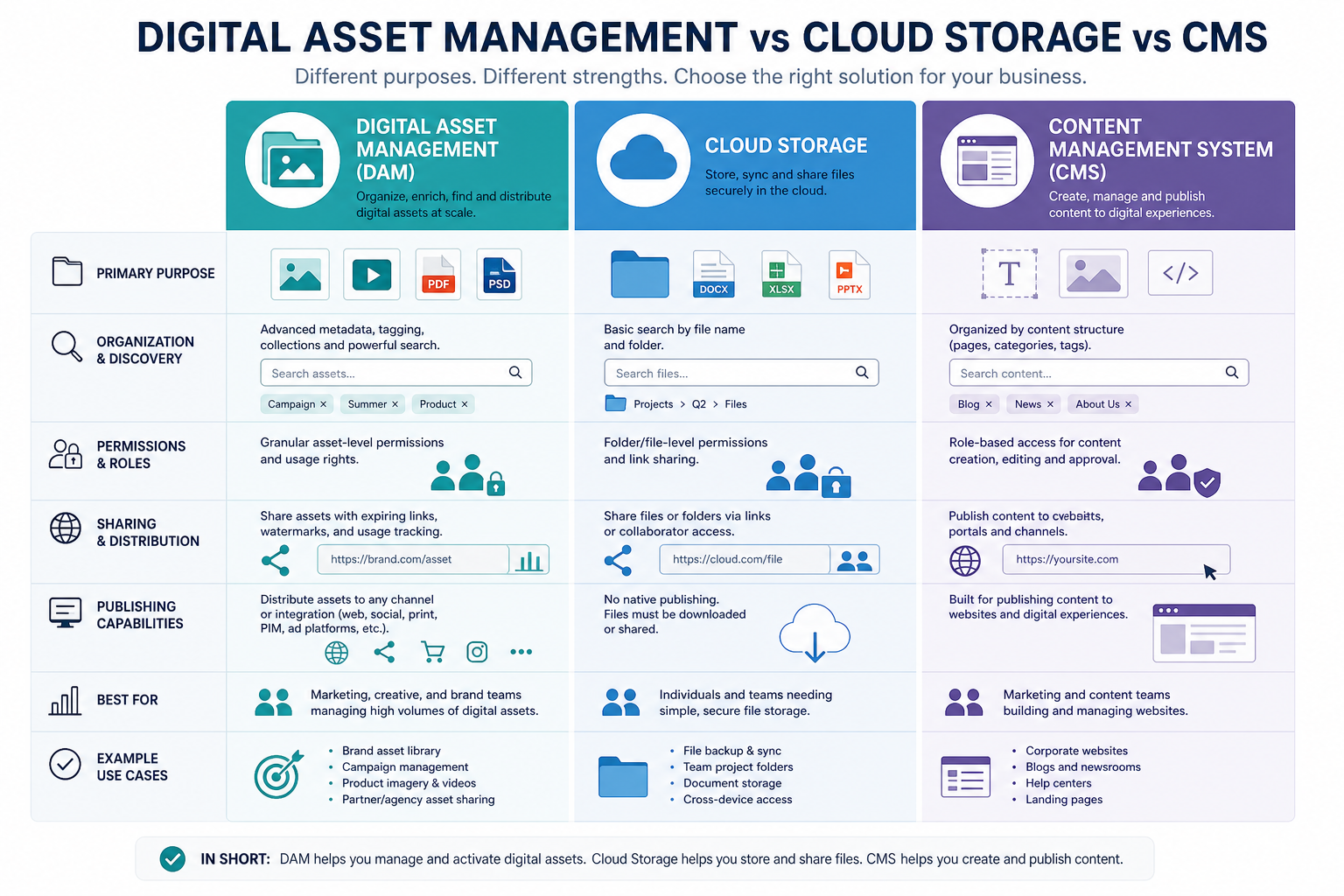
A lot of top-of-funnel readers are really asking a comparison question: do I need a digital asset management platform, or is cloud storage enough?
Here is the simplest breakdown.
Tool | Best for | Strengths | Limitations |
|---|---|---|---|
Digital asset management platform | Organizing, managing, and sharing business files at scale | Search, structure, previews, permissions, secure sharing, collaboration | Some enterprise tools can be overly complex |
Cloud storage | Basic file backup and file syncing | Familiar, simple for personal use | Weak organization, limited control, not built for asset workflows |
CMS | Publishing website content | Great for managing web pages and site content | Not designed to be a central file management system |
A CMS helps publish content. Cloud storage helps hold files. A DAM platform helps manage assets as working business resources.
That distinction matters.
If your team regularly needs to locate approved files, share them safely, manage images, or support collaboration across departments or clients, digital asset management platforms are a better fit than generic storage alone.
Where competitor articles often fall short
Most articles about DAM explain the concept well enough, but many gloss over a few important buying realities.
They focus too much on enterprise complexity
A lot of DAM content is written for large enterprises with huge content operations, complex metadata systems, and advanced automation needs. That is useful for some companies, but not for everyone.
Smaller teams often need:
- Fast setup
- Minimal learning curve
- Clean folder organization
- Affordable pricing
- Secure sharing that just works
This is exactly why a practical platform like AssetHQ is appealing. It gives growing organizations what they actually use, without requiring them to buy into a sprawling enterprise stack.
They underplay usability
Many DAM evaluations treat feature count as the main indicator of quality. In reality, a platform only helps if your team adopts it.
Usability matters because:
- Teams need consistent usage
- Non-technical users need confidence
- File systems should be understandable immediately
- Simplicity reduces training time
They skip pricing clarity
Cost is not just about sticker price. It is also about hidden complexity, implementation overhead, and whether the tool matches your real needs.
AssetHQ’s affordable flat pricing and no hidden fees are meaningful differentiators for teams that want predictable cost and straightforward value.
Benefits of digital asset management platforms for small and growing teams
The biggest DAM benefits are often framed at the enterprise level, but they are just as valuable for smaller businesses.
Less wasted time
Teams spend less time hunting for assets, asking coworkers for files, and sorting through duplicates.
"Computer users spend considerable time managing digital files and folders daily, including downloading, moving, naming, navigating, searching, sharing, and deleting files." - arXiv
That daily drag adds up quickly. Even small workflow improvements can create meaningful gains over time.
Better control over file sharing
Instead of sending attachments and hoping for the best, teams can share files with more confidence through controlled links and access permissions.
This is especially useful when working with freelancers, agencies, or clients.
Cleaner brand and content management
A centralized library helps teams use the right logos, images, documents, and approved materials consistently.
Even if your business is small today, brand consistency becomes harder to maintain as your content library grows.
Easier onboarding for new team members
When files are neatly organized, new hires and collaborators can get productive faster. They do not need tribal knowledge to figure out where everything lives.
More scalable operations
What works for one founder often breaks at five employees. What works for five breaks at twenty.
The right DAM platform helps create a structure you can keep using as your business grows.
Who benefits most from digital asset management platforms
Digital asset management platforms are useful across many industries, but some teams benefit especially quickly.
Solo founders
If you manage proposals, visuals, product screenshots, brand files, and client documents on your own, a simple DAM platform can eliminate clutter early before it grows into a bigger problem.
Startups
Startups create a lot of content quickly. A centralized system helps keep pace without relying on scattered folders and improvised workflows.
Small businesses
Small businesses often need dependable file management but do not want enterprise-level complexity. This is one of the strongest use cases for AssetHQ.
Marketing and design teams
Teams working with images, brand files, presentations, and campaign assets need quick previews, reliable organization, and secure sharing.
Growing cross-functional teams
As more departments need access to shared materials, centralization and permission control become much more important.
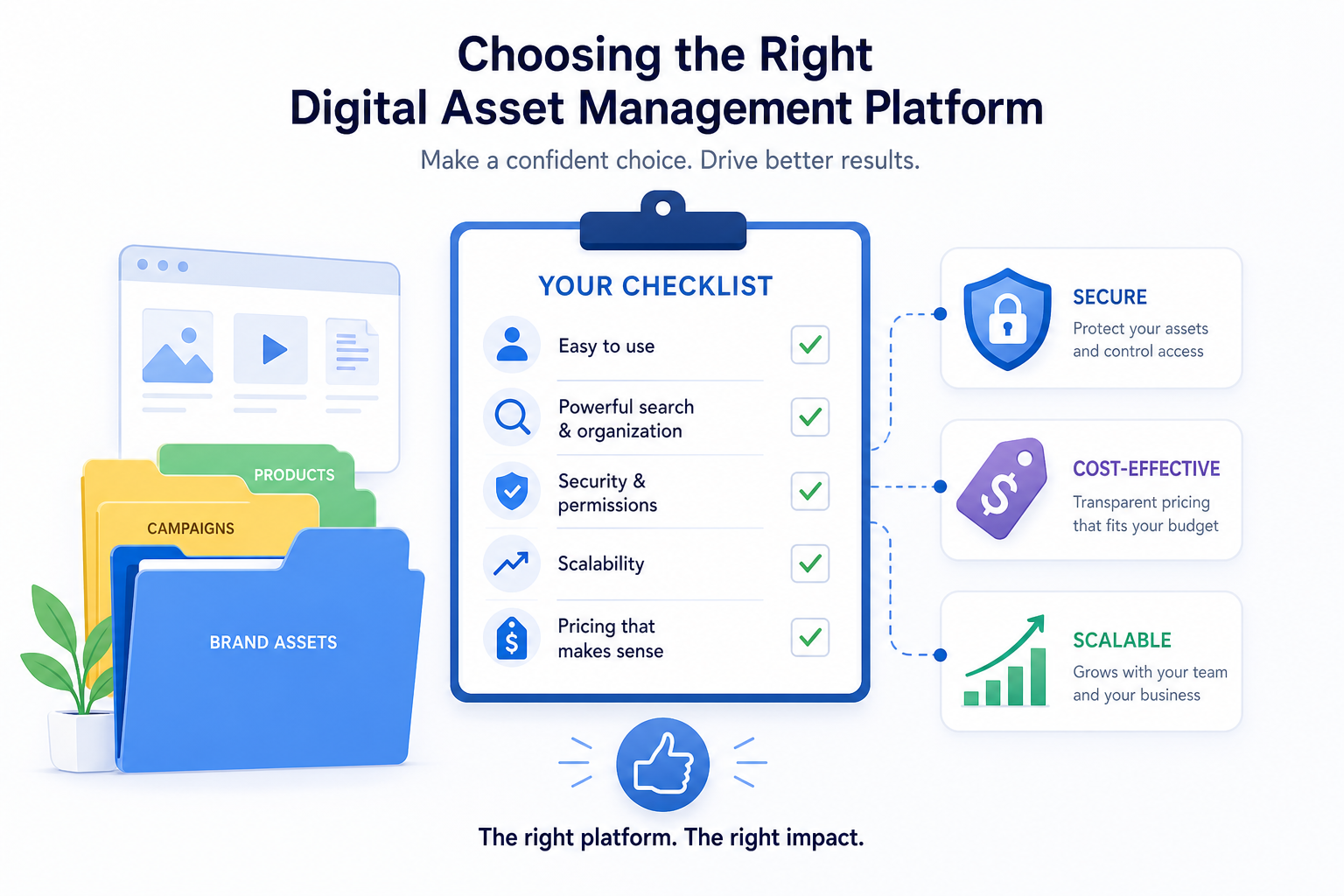
How to choose the right digital asset management platform
Choosing the right DAM platform is less about buying the most advanced product and more about matching the platform to your actual workflows.
Start with your file reality
Ask:
- What kinds of files do we manage most?
- How many people need access?
- Do we share files externally?
- Are images a major part of our workflow?
- Do we need simple structure or advanced enterprise governance?
For many businesses, the winning solution is not the one with the longest feature list. It is the one people will actually use every day.
Prioritize simplicity and speed
A DAM platform should reduce complexity, not introduce more of it.
If your team mainly needs organized file storage, secure sharing, previews, access control, and collaboration, then a simpler platform may deliver better ROI than a heavyweight enterprise system.
Evaluate security carefully
Even if you are not a large enterprise, you still need secure storage and controlled access.
Review:
- Permission settings
- Access restrictions
- Secure link sharing
- Reliability of storage
Think about pricing honestly
Look beyond flashy sales messaging and ask:
- Is pricing predictable?
- Are there hidden fees?
- Will we pay for features we do not need?
- Is the platform scalable for our team size?
AssetHQ’s flat, transparent pricing is a strong fit for businesses that want professional DAM capabilities without budget surprises.
Consider long-term fit
You want a system that works now and still works later.
That means the platform should be:
- Easy for one person to use
- Practical for a small team
- Scalable for a growing organization
- Reliable enough to become your long-term file hub
What a modern DAM platform should feel like
A modern digital asset management platform should not feel intimidating.
It should feel like:
- Opening the exact file you need without friction
- Knowing your team is seeing the same version
- Sharing files externally without worry
- Browsing images visually instead of guessing filenames
- Growing your file system without it becoming messy
- Paying a fair, understandable price for a dependable tool
That is an important difference. Good software does not just add capability. It reduces stress.
Why AssetHQ is a smart fit for businesses that want simplicity
Many DAM vendors aim upward toward enterprise complexity. AssetHQ takes a more practical route.
It is designed for businesses that want:
- Simple and intuitive file management
- Organized storage for documents, images, and shared files
- Image preview and management capabilities
- Secure file sharing with expiring links and access control
- Team collaboration without extra complexity
- Enterprise-grade secure storage
- Fast upload and file access
- Affordable flat pricing with no hidden fees
- A scalable platform suitable for solo users and teams
That combination is especially compelling for founders, startups, and growing businesses that need a professional system now, not an overbuilt one they may never fully use.
Final verdict
Digital asset management platforms exist because modern teams cannot afford file chaos anymore.
As content libraries grow, the cost of disorganization rises with them. Files get harder to find, sharing gets riskier, collaboration gets messier, and teams waste time on tasks that should be simple. A good DAM platform solves that by giving your business one dependable system for storing, organizing, searching, previewing, and sharing files.
For organizations that want those benefits without enterprise-heavy complexity, AssetHQ is a strong choice. It delivers the essentials that matter most: clarity, speed, security, collaboration, and affordability.
If you want a simpler, more reliable way to manage documents, images, and team files, AssetHQ is worth trying. It gives you professional digital asset management in a form your team can actually use every day.
Related Posts

Brand Asset Management Software for Growing Teams
Discover brand asset management software for growing teams and learn how to organize files, share securely, and scale with ease.
min read
Cloud Based Digital Asset Management Benefits
Explore cloud based digital asset management benefits for secure file sharing, simpler teamwork, and organized growth. Try it today now
min read
File Sharing and Storage Made Simple for Teams
Discover file sharing and storage made simple for teams with secure access, better organization, and faster collaboration. Try AssetHQ!
min read